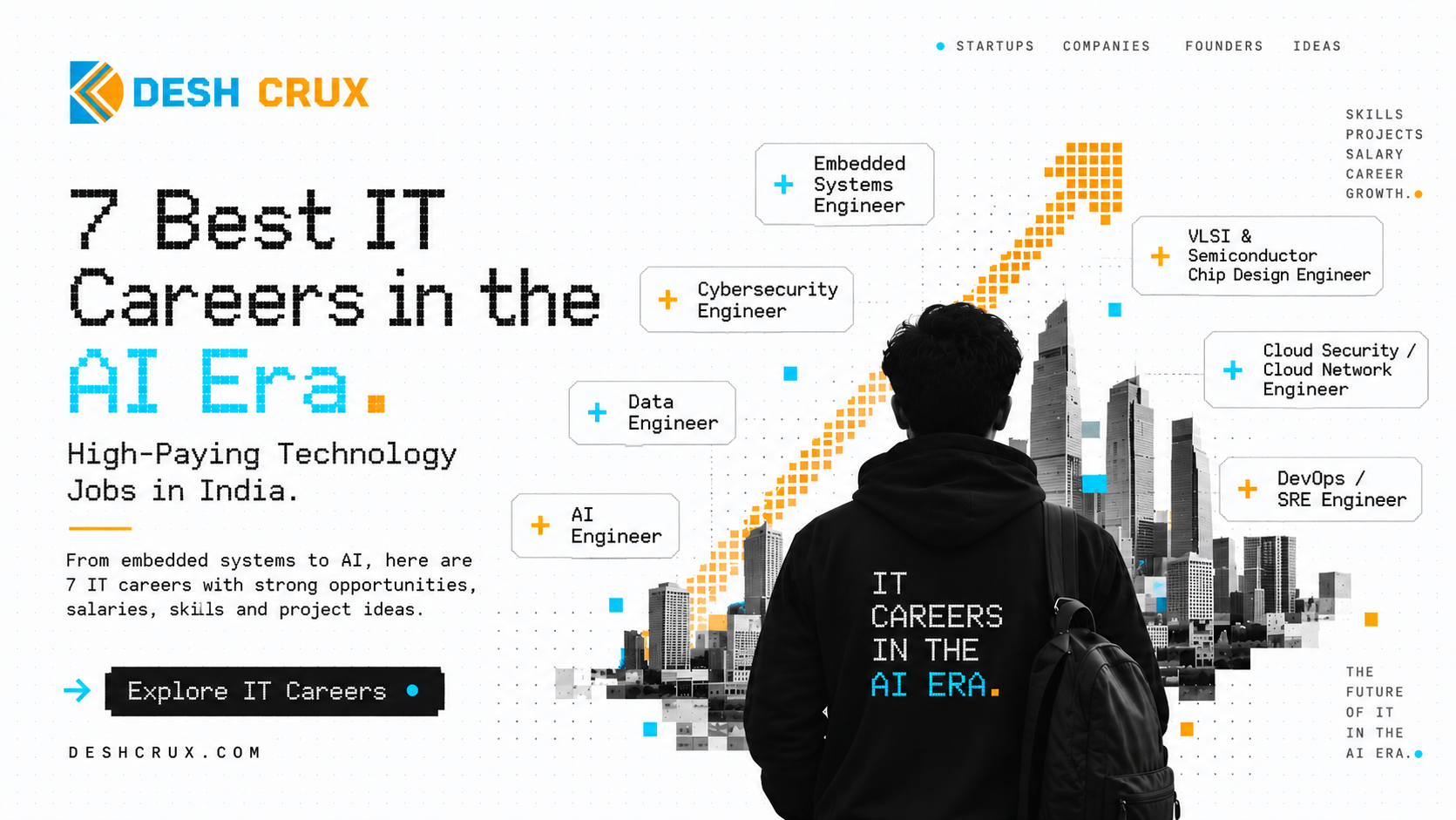
7 Best IT Careers in the AI Era: High-Paying Technology Jobs in India
Artificial intelligence is transforming the technology industry, but several specialised IT careers continue to offer promising opportunities. Explore seven career options, including cybersecurity, AI engineering, cloud computing, DevOps, and data engineering, with estimated salaries, essential skills, and practical project ideas for students and fresh graduates in India.
Artificial intelligence is changing the way the technology industry works. Tasks that once took developers, analysts, and engineers several hours can now be completed much faster with AI-powered tools.
From software development and data analysis to automation, AI is transforming traditional IT roles. This has raised an important question among students and professionals: which technology careers will continue to offer strong opportunities in the AI era?
No technology job is completely immune to automation. However, careers requiring specialised technical knowledge, practical engineering experience, complex problem-solving, and real-world decision-making may remain valuable.
Here are seven promising IT career options in India, along with estimated salaries, essential skills, and practical projects.
1. Embedded Systems Engineer
Embedded systems engineers develop software that operates physical electronic devices. Their work combines programming with hardware integration and is used in automobiles, medical equipment, smart appliances, and industrial machines.
AI can assist with code generation, but hardware testing, debugging physical components, and ensuring device reliability require practical engineering knowledge.
Estimated salary in India: Freshers: ₹4–8 LPA; Mid-level: ₹8–18 LPA; Senior: ₹18–38 LPA.
Essential skills: C programming, Assembly fundamentals, microcontrollers, electronics, and hardware-software integration.
Project idea: Build a smart LED display board using Arduino.
2. Cybersecurity Engineer
Cybersecurity engineers protect organisational networks, applications, servers, and confidential information. Their responsibilities include vulnerability assessment, security monitoring, threat detection, and incident response.
AI can automate log analysis and identify known threats, but investigating unfamiliar attacks and managing complex security incidents still require technical judgement.
Estimated salary in India: Freshers: ₹5–9 LPA; Mid-level: ₹10–20 LPA; Senior: ₹20–40 LPA or more.
Essential skills: Networking, Linux, Python, network security, ethical hacking fundamentals, and incident response.
Project idea: Develop a Python-based network port scanner or packet analyser for authorised testing.
3. VLSI and Semiconductor Chip Design Engineer
VLSI engineers design and develop integrated circuits and microchips used in smartphones, laptops, automobiles, servers, and AI hardware. The field requires knowledge of digital electronics, computer architecture, circuit design, and verification.
AI can support circuit analysis and optimisation, but designing hardware architectures and validating chips require specialised engineering expertise.
Estimated salary in India: Freshers: ₹10–15 LPA; Mid-level: ₹20–40 LPA; Senior: ₹50 LPA–₹1 crore.
Essential skills: Digital electronics, Verilog, SystemVerilog, computer architecture, and circuit verification.
Project idea: Design a 4-bit Arithmetic Logic Unit or digital traffic light controller using Verilog.
4. Cloud Security Engineer / Cloud Network Engineer
Cloud engineers build, configure, maintain, and secure infrastructure on platforms such as AWS, Microsoft Azure, and Google Cloud Platform.
AI can generate configuration scripts and identify vulnerabilities, but designing secure cloud environments and managing complex permissions require engineering knowledge.
Estimated salary in India: Freshers: ₹6–10 LPA; Mid-level: ₹12–25 LPA; Senior: ₹30–50 LPA or more.
Essential skills: Networking, VPC, subnetting, DNS, Linux, AWS or Azure, IAM, and cloud security.
Project idea: Create a private AWS S3 bucket accessible only through an authorised EC2 instance using restricted IAM permissions.
5. DevOps / Site Reliability Engineer (SRE)
DevOps and SRE professionals help organisations deploy applications efficiently, automate infrastructure operations, monitor performance, and maintain service availability.
AI can assist with deployment scripts and troubleshooting, but unexpected outages, infrastructure failures, and complex production problems require engineering judgement.
Estimated salary in India: Freshers: ₹6–10 LPA; Mid-level: ₹12–25 LPA; Senior: ₹30–50 LPA.
Essential skills: Linux, Shell scripting, AWS or Azure, Docker, Kubernetes, CI/CD, Jenkins, and Terraform.
Project idea: Build an automated CI/CD pipeline that tests, builds, and deploys a web application.
6. Data Engineer
Data engineers collect, clean, transform, and organise information from different sources. They develop data pipelines that make reliable information available to analysts, data scientists, and machine learning systems.
AI can assist with SQL queries and Python scripts, but maintaining reliable data pipelines and designing efficient data architectures require technical expertise.
Estimated salary in India: Fresher Data Analyst: ₹4–8 LPA; Mid-level Data Engineer: ₹12–25 LPA; Senior: ₹30–50 LPA.
Essential skills: SQL, Python, ETL, database management, cloud computing, and data pipeline architecture.
Project idea: Build an automated ETL pipeline that collects information from a public API, processes it, and stores it in PostgreSQL.
7. AI Engineer
AI engineers develop, integrate, and deploy intelligent applications such as chatbots, recommendation systems, machine learning solutions, and generative AI tools.
Businesses across finance, healthcare, education, and e-commerce are increasingly exploring AI-powered applications. However, building reliable AI systems requires much more than knowing how to use AI tools.
Estimated salary in India: Freshers: ₹6–12 LPA; Mid-level: ₹15–35 LPA; Senior: ₹50 LPA–₹1 crore or more.
Essential skills: Python, linear algebra, calculus, probability, statistics, Pandas, Scikit-learn, PyTorch, deep learning, LLMs, and RAG.
Project idea: Develop a PDF chatbot using Retrieval-Augmented Generation (RAG) that answers questions based on uploaded documents.
Final Thoughts: Choosing an IT Career in the AI Era
Artificial intelligence is changing the technology industry, but it does not necessarily mean that traditional IT careers will disappear. Instead, the skills required to succeed in these professions are evolving.
Embedded systems, cybersecurity, semiconductor engineering, cloud infrastructure, DevOps, data engineering, and AI development all offer different career opportunities.
No profession is completely protected from automation. The most practical approach is to develop strong fundamentals, gain hands-on experience, build real-world projects, and learn to use AI tools effectively.
For students and fresh graduates, choosing a career should involve more than looking at salary figures. Personal interests, technical strengths, and willingness to develop specialised skills also matter.
The future of IT will not only be about using AI tools. It will also be about building intelligent systems, securing digital infrastructure, solving complex problems, and creating technology that people can depend on.
Which of these seven IT careers interests you the most? Share your thoughts and the technical skills you are currently learning.
Building something in India?
Get your company listed on Desh Crux and be found by founders, investors and customers.