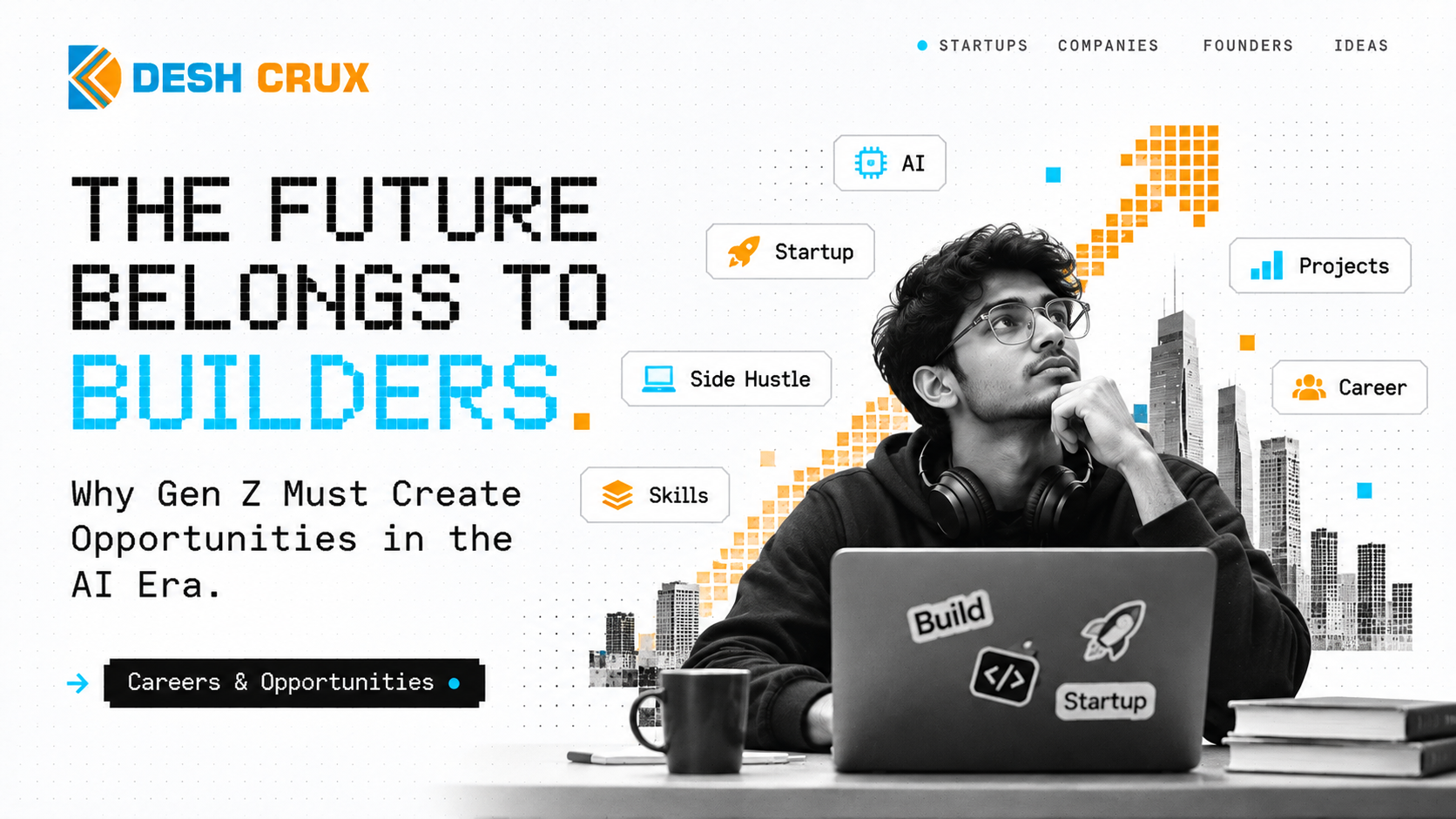
Why Gen Z Should Focus on Building Skills and Creating Opportunities in the Age of AI
As AI transforms the workplace and competition for jobs increases, Gen Z is exploring entrepreneurship, practical skills and alternative career opportunities. Discover why curiosity, skill combinations, personal projects and adaptability can help young people build a more flexible professional future.
Why Gen Z Should Focus on Building Skills and Creating Opportunities in the Age of AI
For today's generation, building a career is becoming more complicated than simply earning a degree and applying for jobs. With increasing competition, changing workplace expectations and the rapid development of artificial intelligence (AI), young people are beginning to explore new ways to create professional opportunities.
For many graduates, completing college, earning certifications and gaining internship experience does not automatically guarantee a suitable job. The competition for entry-level positions can be intense, while government jobs continue to attract large numbers of applicants.
This changing environment raises an important question: should young people focus only on finding traditional employment, or should they also learn how to create opportunities for themselves?
The Traditional Career Path Is Changing
For decades, the conventional career path was relatively straightforward. Students were expected to complete their education, secure a stable job, purchase a home, support their families and gradually build a financially comfortable life.
However, this traditional approach is becoming more challenging for many young professionals.
Rising living costs, increasing competition for employment and changing industry requirements are influencing how people think about their careers. Artificial intelligence is also transforming how businesses operate and what they expect from employees.
As a result, having a degree alone may not be enough to stand out in an increasingly competitive job market. Practical experience, problem-solving abilities, adaptability and the willingness to learn new skills are becoming important parts of professional development.
Why Gen Z Is Becoming More Interested in Multiple Income Streams
Today's young generation is increasingly interested in entrepreneurship, freelancing, content creation, personal branding and side projects.
Many are trying to develop multiple skills alongside their formal education or full-time employment. Some are building websites, launching small businesses, creating digital products or offering services online.
The motivation is not always about becoming extremely wealthy. For many people, it is about having more financial security, professional independence and the flexibility to explore different career opportunities.
However, there is an interesting contradiction. While young people want to escape the traditional rat race, they sometimes create a new version of it for themselves.
Every free hour becomes an opportunity to learn another skill, complete another certification, start another project or find another source of income. Even taking a break can begin to feel unproductive.
Building a career is important, but constantly working without direction can lead to unnecessary pressure. Long-term progress requires more than simply staying busy.
Curiosity Can Become a Valuable Career Advantage
One of the most underrated qualities in professional development is curiosity.
Instead of learning something only because it appears in a job description, young people can benefit from exploring subjects they genuinely enjoy understanding.
Entrepreneur and investor Naval Ravikant has popularised the concept of specific knowledge, which highlights the value of developing knowledge and abilities that are difficult to replicate and often connected to an individual's natural interests and experiences.
These interests can come from almost anywhere. Someone might enjoy programming, writing, business, sports, statistics, cybersecurity, technology or design.
The real opportunity often emerges when people combine different interests instead of limiting themselves to a single area.
Combining Different Skills Can Create New Career Opportunities
Being exceptionally good at one skill is valuable, but combining multiple complementary skills can help someone develop a distinctive professional advantage.
For example:
- Programming and sales: Someone who understands software development and customer acquisition may be well suited to technical sales, solutions engineering or go-to-market engineering roles.
- Sports and data analytics: A person interested in football and statistics could explore sports analytics, performance analysis or sports data science.
- Finance and writing: Combining financial knowledge with strong communication skills can create opportunities in financial journalism, research and educational content.
- Technology and entrepreneurship: Someone who understands software development and business operations may be able to identify problems and build products around them.
- Design and marketing: Combining visual creativity with an understanding of consumer behaviour can open opportunities in branding and digital marketing.
These combinations demonstrate that career opportunities do not always fit neatly into traditional job categories. Sometimes, the advantage comes from connecting two or three different areas of knowledge.
How Artificial Intelligence Is Changing the Way People Build Things
Artificial intelligence is creating new possibilities for individuals who want to experiment, develop products and turn ideas into practical solutions.
Tasks that previously required significant technical resources can now be approached with the assistance of AI-powered tools. Individuals can use these tools to research ideas, write code, develop prototypes, create content and automate certain workflows.
This does not mean that AI has eliminated the need for technical expertise or professional teams. Building a reliable product still requires problem-solving, testing, domain knowledge and an understanding of real customer needs.
However, AI is lowering some barriers to experimentation, making it easier for individuals to test ideas before investing significant time or money.
A student with an interesting idea can develop a basic prototype, publish a project on GitHub, write about the development process or share the results with professionals working in the industry.
Such projects can become examples of practical experience, often described as proof of work.
Why Building Projects Can Be More Valuable Than Collecting Certifications
Certifications and online courses can help people understand new subjects, but completing a course does not always demonstrate the ability to apply that knowledge.
Practical projects provide another way to demonstrate skills.
For example, a computer science student interested in web development could build a useful online tool. Someone interested in writing could publish well-researched articles. A student interested in business could research a market and develop a small business model.
These experiments can help individuals understand their interests, identify knowledge gaps and develop practical experience.
Not every project needs to become a successful business. Some ideas may fail, attract little attention or never generate revenue. That does not make the experience worthless.
Each experiment can provide lessons about technology, customers, communication and personal interests.
How Young People Can Start Creating Their Own Opportunities
Creating opportunities does not necessarily require significant investment or a complicated business plan. It can begin with small, consistent experiments.
- Explore genuine interests: Identify subjects you naturally enjoy learning about rather than following every popular career trend.
- Develop complementary skills: Combine technical, creative, analytical or communication abilities to build a broader professional profile.
- Build practical projects: Create websites, applications, research projects, digital products or other work that demonstrates your abilities.
- Develop an online presence: Share useful work through professional platforms, portfolios, GitHub or personal websites.
- Connect with industry professionals: Reach out to people working in areas that interest you and learn from their experiences.
- Experiment with small ideas: Try freelancing, internships, content creation or entrepreneurship without immediately making major financial commitments.
- Keep learning and adapting: Review your progress and adjust your direction as industries, technologies and personal interests change.
Creating Opportunities Does Not Mean Abandoning Traditional Careers
There is an important distinction between building opportunities and taking unnecessary risks.
Not everyone needs to leave college, quit a stable job or start a company. Traditional employment continues to provide valuable experience, financial stability and opportunities to develop professional skills.
Entrepreneurship also comes with uncertainty, financial responsibilities and the possibility of failure. Having an interest in something does not automatically mean there is a market willing to pay for it.
A sensible approach is to explore new opportunities while maintaining realistic expectations and managing financial responsibilities.
Young professionals can continue their education or employment while gradually developing projects, building networks and testing business ideas.
Final Thoughts: Your Ability to Learn and Adapt Matters
The future of work may not follow the same career patterns that previous generations experienced. Technology, artificial intelligence and changing business requirements are creating new challenges as well as new possibilities.
In this environment, young people should not measure their progress only by the number of certificates they earn or the number of job applications they submit.
Developing useful skills, exploring different interests, building practical projects and understanding real-world problems can help create a stronger foundation for the future.
You do not need to discover your perfect career direction in a single day. Sometimes, writing an article, building a small tool, trying an internship or exploring an unfamiliar subject can be the beginning of something unexpected.
Not every experiment will succeed, and that is part of the process.
In a world where careers are becoming less predictable, the ability to stay curious, learn continuously, create useful things and adapt to change may become one of the most valuable professional advantages of all.
Building something in India?
Get your company listed on Desh Crux and be found by founders, investors and customers.