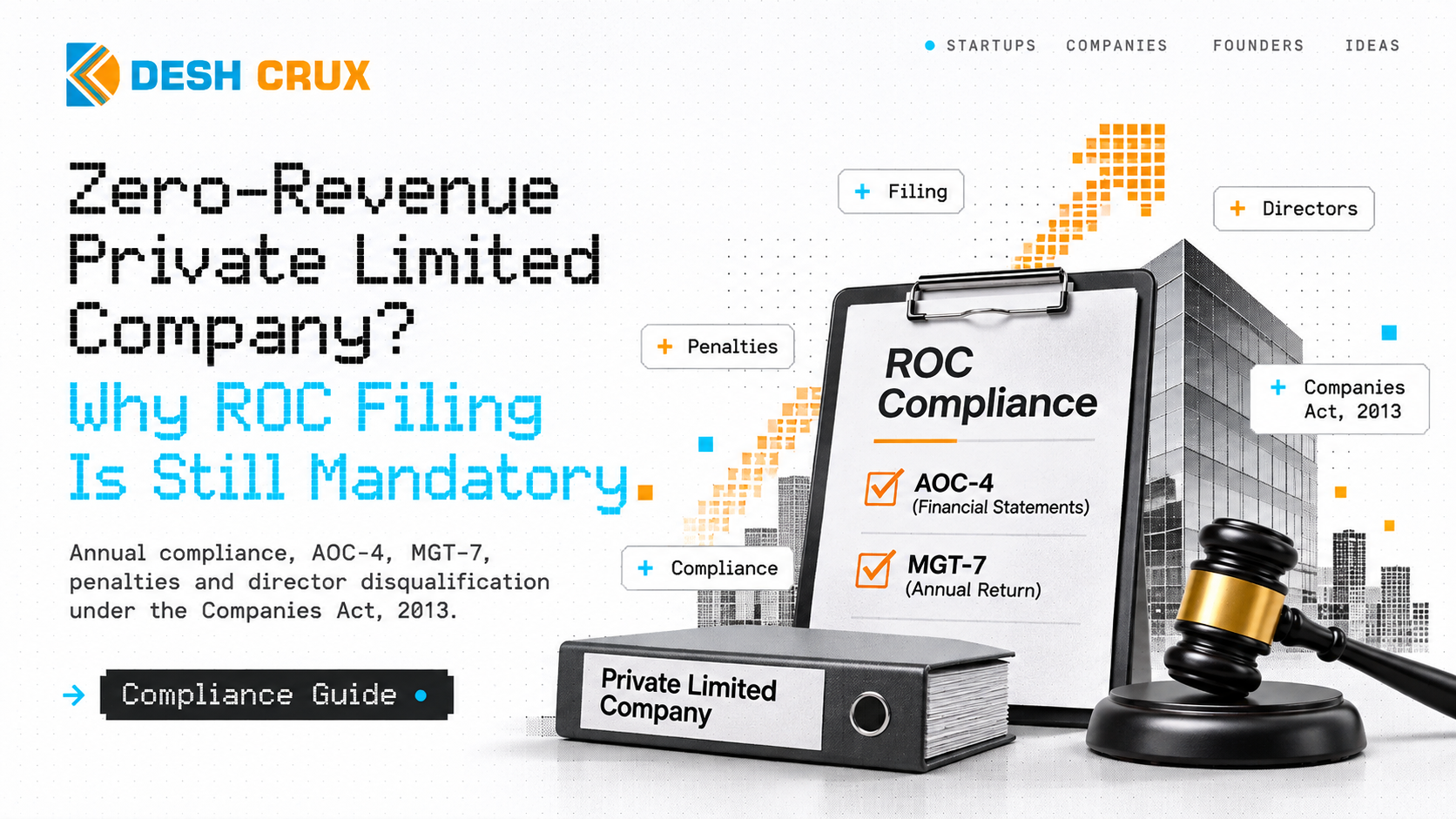
Zero-Revenue Private Limited Company? ROC Filing Rules, Penalties and Compliance in India
Does a private limited company need to file ROC returns even with zero revenue? Understand mandatory annual compliance, AOC-4 and MGT-7 filings, late fees, penalties and director disqualification under the Companies Act, 2013.
Zero-Revenue Private Limited Company? Why Annual ROC Compliance Is Still Mandatory in India
Registering a private limited company in India comes with ongoing legal responsibilities. Even if a company has not started operations, generated revenue or conducted any business transactions during the financial year, it may still need to complete its annual compliance requirements with the Registrar of Companies (ROC).
Many first-time entrepreneurs assume that a company with zero revenue does not need to file annual returns. However, this misunderstanding can lead to additional filing fees, financial penalties and legal complications.
Under the Companies Act, 2013, applicable statutory obligations generally continue even when a company remains inactive. Understanding these requirements early can help founders avoid unnecessary compliance problems.
Zero Revenue Does Not Mean Zero Compliance
Once a private limited company is incorporated, it becomes subject to various provisions of the Companies Act, 2013. These obligations do not automatically disappear simply because the business has no customers, income or commercial activity.
Two important annual ROC filings that companies generally need to complete are:
- Form AOC-4: Used to submit the company's financial statements to the Registrar of Companies.
- Form MGT-7: Used to file the company's annual return.
- Form MGT-7A: The prescribed abridged annual return form for One Person Companies (OPCs) and small companies.
Companies must also consider other applicable requirements, including statutory audits, annual general meetings (AGMs), board meetings and maintenance of statutory records.
Therefore, keeping a company registered without conducting business does not automatically exempt it from annual compliance responsibilities.
What Happens If You Miss ROC Filing Deadlines?
Missing statutory filing deadlines can result in additional financial liabilities. The Companies Act, 2013 provides penalties for companies that fail to submit their financial statements and annual returns within the prescribed time.
1. Penalty for Late AOC-4 Filing Under Section 137
Section 137 deals with filing financial statements with the Registrar of Companies. Failure to comply can attract a penalty of ₹10,000 for the company, with an additional ₹100 for every day the default continues, subject to a maximum penalty of ₹2 lakh.
The managing director, CFO or other officers responsible for the default may also face penalties, depending on their role and the applicable provisions.
2. Penalty for Late MGT-7 Filing Under Section 92
Section 92 covers the filing of annual returns. Failure to submit the annual return within the prescribed period can attract a penalty of ₹10,000, along with an additional ₹100 for every day the default continues.
The maximum penalty is ₹2 lakh for the company and ₹50,000 for an officer in default.
It is important to understand that statutory penalties and additional ROC filing fees are separate. The actual amount payable depends on the nature of the default, the delay and the applicable MCA fee rules.
Can Directors Be Disqualified for Non-Compliance?
Yes. Prolonged non-compliance can have serious consequences for company directors.
Under Section 164(2) of the Companies Act, 2013, a director may become disqualified if the company fails to file its financial statements or annual returns for three consecutive financial years.
Such disqualification can prevent the individual from being reappointed as a director or appointed as a director in another company for five years.
This is particularly important for startup founders who may want to establish multiple businesses or take up directorships in other companies in the future.
Why Early-Stage Startup Founders Should Take Compliance Seriously
Consider a founder who incorporates a private limited company to develop a technology product. During the first year, the company generates no revenue because the founder is still working on product development.
Instead of completing the required filings, the founder decides to postpone compliance until the product launches or the company receives investment.
As time passes, filing obligations remain pending and additional financial liabilities may arise. When the founder eventually approaches investors, brings in new shareholders or plans another business venture, unresolved compliance issues can create complications.
Investors and professional advisers may also examine statutory records, financial statements and company filings during due diligence.
The important lesson is that legal compliance should be part of a startup's operating plan from the beginning, not something considered only after generating revenue.
Private Limited Company vs LLP: Which Structure Should You Choose?
Not every new business needs to register as a private limited company immediately. The appropriate structure depends on business goals, ownership requirements, investment plans and expected operations.
Private Limited Company
A private limited company may be suitable for entrepreneurs planning to raise equity investment, issue shares, build a scalable startup or bring multiple shareholders into the business.
Limited Liability Partnership (LLP)
An LLP may be appropriate for certain professional businesses, service providers and small teams looking for limited liability with a different compliance structure.
Sole Proprietorship
A sole proprietorship may work for an individual starting a small business with relatively simple ownership requirements. However, it does not provide the same separate legal identity or limited liability protection as a private limited company or LLP.
Choosing a business structure based only on its initial registration cost can result in unnecessary expenses and administrative responsibilities later.
How Can Companies Avoid ROC Compliance Problems?
Founders can reduce the risk of penalties and missed deadlines by following a few practical steps:
- Maintain proper accounting records from the date of incorporation.
- Complete the applicable statutory audit and prepare financial statements.
- Keep track of AOC-4 and MGT-7 or MGT-7A filing deadlines.
- Maintain required board meeting records and statutory registers.
- Consult a qualified Chartered Accountant or Company Secretary for compliance guidance.
- Review pending filings and outstanding liabilities if the company has remained inactive.
Final Thoughts
Registering a private limited company is only the first step in building a legally compliant business. Whether a company generates substantial revenue or has no business income, its applicable statutory responsibilities must be taken seriously.
Before incorporating a company, founders should understand the annual filing requirements, accounting responsibilities and long-term compliance costs associated with their chosen business structure.
If your company is already registered but remains inactive, consider consulting a qualified professional to review its filing status and identify the appropriate next steps.
Disclaimer: This article is intended for general informational and educational purposes only. It does not constitute legal, tax or professional compliance advice. The applicability of individual filings, fees and penalties depends on the company's circumstances and the laws in force. Consult a qualified professional for advice specific to your company.
Building something in India?
Get your company listed on Desh Crux and be found by founders, investors and customers.